South Florida's Sun-Sentinel newspaper reports that Florida resident Pam Wall was able to relax while the rest of her neighbors were cloaked in darkness after Hurricane Wilma struck. The Fort Lauderdale resident still had all her modern conveniences -- working lights, TV, hairdryer, coffee pot and refrigerator -- all thanks to solar power.
Two solar-powered panels attached to the homemade sailboat docked in her back yard enabled Wall and her husband to enjoy all the noise-free, stress-free power they wanted while they waited almost three weeks for electricity to be restored to their house.
"We just lived on the boat and all the power we needed was from our solar panels," she said. "We didn't worry about fuel."
Wall is one of a small number of South Floridians who found solar power to be an effective alternative during times of disaster. The group's ranks are expected to grow, industry officials say, as residents realize how vulnerable they are to power outages and gas shortages each hurricane season. Also, new tax credits that go into affect on the first of January allow homeowners and businesses to deduct 30 percent of the cost of a solar-power system from their taxes, for a total credit of up to $2,000, according to the Energy Policy Act of 2005.
Instead of buying a gas generator this year in preparation for hurricane season, Dan Fieldman of Jupiter bought two solar panels for $683. After Wilma knocked out the electrical grid, he laid the panels out on his lawn, hooked them up to a car battery, attached a few small appliances and watched the World Series on TV as he checked his email.
"It was dead silent, it didn't stink up the place and I didn't have to worry about buying gas," he said. "I had a little color television and a laptop and a refrigerator. It was great."
There are drawbacks. Solar power is more expensive than regular electricity, needs sunshine to work and can be more difficult to set up.
Nonetheless, local governments are also getting in on the action, using solar-powered traffic signals and lights to make roads safer during outages. The city of Coral Springs used seven solar signals after the storm, and officials found them so successful they have ordered another four despite their hefty price tag of $10,000 each.
"They worked out wonderfully," said Police Chief Duncan Foster. "They have proved themselves in the man-hours we saved directing traffic. We didn't have to put an officer in those intersections and risk their safety."
Florida Solar Energy Center in Brevard, Florida
Jim Fenton, director of the Florida Solar Energy Center, the largest state-supported renewable energy research institute in the United States and a branch of the University of Central Florida, wants to take things a step further and lobby the state to install mobile solar-power systems at local schools that serve as hurricane shelters. That way, he said, the schools can save money on their energy bill during the year, have power if electricity is knocked out, and send out the mobile system after a storm if it is needed elsewhere.
For most, however, the advantage of solar energy during this year's outage was simply a surprise benefit to something they originally did for economic, environmental or practical reasons.
Tim Williamson, a Hollywood resident and pastor of Hollywood Hills Alliance Church, had a solar water heater installed at his home five years ago to save about $30 a month on his energy bill. It was such a luxury to have warm water after Wilma, he now says he would consider hooking up other solar-power systems.
"We were taking nice hot showers when everyone else was taking cold ones," Williamson said.
The main reason more people don't have a solar-power home is simple. It's pricey.
Diane Marshall of Key Largo spent about $24,000 to set up her solar-power home, which also purifies its own water and won her the 2005 "Green Building" Award from The Council for Sustainable Florida.
As a result, while there are tens of thousands of people with solar water heaters in the state, there are only a few hundred who have solar electric systems that power their homes, estimated Jim Dunlop, an engineer with the Florida Solar Energy Center.
Even with all that expense, there are technical challenges associated with using solar power during an outage, experts explain.
First off, there are two kinds of solar power: solar electric and solar thermal.
Solar-electric systems, also known as photovoltaic systems, use silicon cells on a solar panel to convert the sun's energy into direct current electricity. An inverter turns this electricity into power most appliances can use.
But to work at night and during periods of cloudiness, solar-electric homes need to incorporate a battery system that stores the solar power generated during daylight. Otherwise, they only work when the sun is shining.
Some choose to forgo such battery systems because they cost about 25 percent more, Dunlop said.
Solar water heaters, an example of a solar-thermal system, work much more simply by using the sun's energy to directly heat water. But they also have their quirks. For example, homeowners need to make sure they have a solar-powered water pump -- not an electric one -- as part of their solar water heater if they want hot water during a prolonged blackout.
Julie Joyce of Fort Lauderdale learned this the hard way when she lost hot water a few days after Wilma because her pump was electric. Two weeks into the outage, Joyce paid a company $640 to install a solar pump.
"Ahh, it was wonderful," she said, recalling her first hot shower, saying the price was worth it. "It's up there forever now."
Another concern: solar panels must be installed correctly so the panels don't fly off in a storm or become damaged.
Bone, the owner of a solar home on No Name Key, said the panels on his house did fine in the hurricane, but he has seen some homes where they have not. He said there are two ways to mount panels on roofs -- flush or, as was common in the 1980s before Hurricane Andrew, tilted to the south for maximum sun exposure. Tilted panels have a greater chance of catching wind and tearing off, he said. Most modern installations must meet strict building codes that certify they can withstand hurricane force winds.
Despite such drawbacks, those who have tried solar power say it is easy to get hooked on thesilent, abundant energy source -- both during an outage and after.
"If I ever redo my house, I would put solar panels everywhere," said Wall, the solar sailboat owner. "You can use it all the time, not just during a hurricane."
The above shown are pictures of a number of machine that make use of the solar energy to function. We all know that solar panels are used to trap the sun's light energy to convert into electrical and other forms of energy, but have you ever wondered about the science behind all this conversion to give the wonderful electricity to power the machines?
Well, the solar panels consist of many photovolatic cells. The solar cells that you see on calculators and satellites are photovoltaic cells or modules (modules are simply a group of cells electrically connected and packaged in one frame). Photovoltaics, as the word implies (photo = light, voltaic = electricity), convert sunlight directly into electricity. Once used almost exclusively in space, photovoltaics are used more and more in less exotic ways. They could even power your house. Photovoltaic (PV) cells are made of special materials called semiconductors such as silicon, which is currently the most commonly used. Basically, when light strikes the cell, a certain portion of it is absorbed within the semiconductor material. This means that the energy of the absorbed light is transferred to the semiconductor. The energy knocks electrons loose, allowing them to flow freely. PV cells also all have one or more electric fields that act to force electrons freed by light absorption to flow in a certain direction. This flow of electrons is a current, and by placing metal contacts on the top and bottom of the PV cell, we can draw that current off to use externally. For example, the current can power a calculator. This current, together with the cell's voltage (which is a result of its built-in electric field or fields), defines the power (or wattage) that the solar cell can produce.
That's the basic process, but there's really much more to it. Let's take a deeper look into one example of a PV cell: the single-crystal silicon cell. Silicon has some special chemical properties, especially in its crystalline form. An atom of silicon has 14 electrons, arranged in three different shells. The first two shells, those closest to the center, are completely full. The outer shell, however, is only half full, having only four electrons. A silicon atom will always look for ways to fill up its last shell (which would like to have eight electrons). To do this, it will share electrons with four of its neighbor silicon atoms. It's like every atom holds hands with its neighbors, except that in this case, each atom has four hands joined to four neighbors. That's what forms the crystalline structure, and that structure turns out to be important to this type of PV cell. We've now described pure, crystalline silicon. Pure silicon is a poor conductor of electricity because none of its electrons are free to move about, as electrons are in good conductors such as copper. Instead, the electrons are all locked in the crystalline structure. The silicon in a solar cell is modified slightly so that it will work as a solar cell.
A solar cell has silicon with impurities -- other atoms mixed in with the silicon atoms, changing the way things work a bit. We usually think of impurities as something undesirable, but in our case, our cell wouldn't work without them. These impurities are actually put there on purpose. Consider silicon with an atom of phosphorous here and there, maybe one for every million silicon atoms. Phosphorous has five electrons in its outer shell, not four. It still bonds with its silicon neighbor atoms, but in a sense, the phosphorous has one electron that doesn't have anyone to hold hands with. It doesn't form part of a bond, but there is a positive proton in the phosphorous nucleus holding it in place.
When energy is added to pure silicon, for example in the form of heat, it can cause a few electrons to break free of their bonds and leave their atoms. A hole is left behind in each case. These electrons then wander randomly around the crystalline lattice looking for another hole to fall into. These electrons are called free carriers, and can carry electrical current. There are so few of them in pure silicon, however, that they aren't very useful. Our impure silicon with phosphorous atoms mixed in is a different story. It turns out that it takes a lot less energy to knock loose one of our "extra" phosphorous electrons because they aren't tied up in a bond -- their neighbors aren't holding them back. As a result, most of these electrons do break free, and we have a lot more free carriers than we would have in pure silicon. The process of adding impurities on purpose is called doping, and when doped with phosphorous, the resulting silicon is called N-type ("n" for negative) because of the prevalence of free electrons. N-type doped silicon is a much better conductor than pure silicon is.
Actually, only part of our solar cell is N-type. The other part is doped with boron, which has only three electrons in its outer shell instead of four, to become P-type silicon. Instead of having free electrons, P-type silicon ("p" for positive) has free holes. Holes really are just the absence of electrons, so they carry the opposite (positive) charge. They move around just like electrons do.
The interesting part starts when you put N-type silicon together with P-type silicon. Remember that every PV cell has at least one electric field. Without an electric field, the cell wouldn't work, and this field forms when the N-type and P-type silicon are in contact. Suddenly, the free electrons in the N side, which have been looking all over for holes to fall into, see all the free holes on the P side, and there's a mad rush to fill them in.
As much as we want to be able to capture the maximum amount of energy as possible, there is also energy loss in the solar cells. Visible light is only part of the electromagnetic spectrum. Electromagnetic radiation is not monochromatic -- it is made up of a range of different wavelengths, and therefore energy levels. (See How Special Relativity Works for a good discussion of the electromagnetic spectrum.) Light can be separated into different wavelengths, and we can see them in the form of a rainbow. Since the light that hits our cell has photons of a wide range of energies, it turns out that some of them won't have enough energy to form an electron-hole pair. They'll simply pass through the cell as if it were transparent. Still other photons have too much energy. Only a certain amount of energy, measured in electron volts (eV) and defined by our cell material (about 1.1 eV for crystalline silicon), is required to knock an electron loose. We call this the band gap energy of a material. If a photon has more energy than the required amount, then the extra energy is lost (unless a photon has twice the required energy, and can create more than one electron-hole pair, but this effect is not significant). These two effects alone account for the loss of around 70 percent of the radiation energy incident on our cell.
Why can't we choose a material with a really low band gap, so we can use more of the photons? Unfortunately, our band gap also determines the strength (voltage) of our electric field, and if it's too low, then what we make up in extra current (by absorbing more photons), we lose by having a small voltage. Remember that power is voltage times current. The optimal band gap, balancing these two effects, is around 1.4 eV for a cell made from a single material.
We have other losses as well. Our electrons have to flow from one side of the cell to the other through an external circuit. We can cover the bottom with a metal, allowing for good conduction, but if we completely cover the top, then photons can't get through the opaque conductor and we lose all of our current (in some cells, transparent conductors are used on the top surface, but not in all). If we put our contacts only at the sides of our cell, then the electrons have to travel an extremely long distance (for an electron) to reach the contacts. Remember, silicon is a semiconductor -- it's not nearly as good as a metal for transporting current. Its internal resistance (called series resistance) is fairly high, and high resistance means high losses. To minimize these losses, our cell is covered by a metallic contact grid that shortens the distance that electrons have to travel while covering only a small part of the cell surface. Even so, some photons are blocked by the grid, which can't be too small or else its own resistance will be too high.
Speech by Assoc Prof Koo Tsai Kee, Senior Parliamentary Secretary, Ministry of the Environment and Water Resources, at the Launch of the Solar Roof Project Singapore, 24 March 2006, at the German European School Dr. Wolf Gether, Deputy Director General of the Federal Ministry of Economy and Technology Mr Berthold Breid, Project Manager, Renewable Energy, DENA Mr Olaf Fleck, Director, Sunset Energietechnik, Mr Gheter Boos, Principal, German European School.
Distinguished Guests, Ladies and Gentlemen Good Afternoon. It is my pleasure to be here today to witness the launch of Singapore's first grid-connected photovoltaic (PV) system. It is an exciting milestone for Singapore in the harnessing of energy capabilities.
Rising Fuel Oil Prices and Growth of Solar Energy
2 Since the dawn of mankind, fossil fuels have been the main source of energy. Even though the world had made great progress in technology in the last few decades or so, fossil fuels continued to play an integral part in power generation, allowing us to enjoy the many comforts of modern life, such as lighting, air-conditioning and transport. So much so that we have taken all these for granted now.
3 However, in recent years, high and unstable fuel oil prices have been affecting businesses and creating great uncertainties for economies. Scientists have linked carbon dioxide, a by-product of fuel combustion, to global warming and a rise in sea levels. Singapore, being a small island state, is not ignoring these concerns.
4 Singapore has already committed to reduce its carbon intensity, which is the amount of carbon dioxide emission per GDP dollar, by 25% from 1990-levels by the year 2012. In fact, we had already achieved a 22% reduction in 2004 and are therefore well on track to meet our target. Singapore's accession to the Kyoto Protocol this year also heralds a new era for Singapore to play a greater role in mitigating the impact of climate change.
Solar Energy Initiatives in Singapore
5 Is solar energy therefore a solution to the energy problem that the world faces today? Worldwide, solar energy use has been growing at a phenomenal rate of 29% per annum from 1971 to 2003 [1]. A significant portion of this growth is being driven by countries such as Germany, Japan and the United States.
6 Singapore also recognises the benefits and growth potential of solar energy. Even though there is a constant presence of significant cloud cover over Singapore, we still enjoy a substantial amount of sunshine throughout the year. Thus, there is vast potential for us to tap into solar energy, a clean and renewable energy source which can assist in our efforts to reduce our carbon intensity.
7 Singapore Government agencies and institutions have been stepping up efforts in recent years to promote solar energy use. Several agencies have been testing or using photovoltaic or PV power for several years. For example, the Sembawang Town Council implemented a 3 kilowatts-peak (kWp) PV system at a multi-storey car park at Bangkit Road in 2000 to provide power for lighting. This project was part of the town council's effort to implement green power and save energy. There are also other building-integrated PV systems at Changi Naval Base and Biopolis, as well as the demonstration projects on PV technology at the Singapore Polytechnic and the BCA's Construction Industry Training Institute.
8 Singapore continues to attract pioneering investments in solar energy. Other German companies with solar related businesses have also expressed interest in setting up offices here, and I'm hopeful today's event will herald more foreign investments in our renewable energy market.
9 To increase the level of knowledge and stimulate interest in solar energy implementation among architectural and engineering professionals here, the National Environment Agency (NEA) has also been conducting training seminars with the assistance of experts from the solar energy industry and tertiary institutions. I am told that the response to these seminars has been very good and the level of interest has been high. This shows that more organisations are recognising the technological advances being made in this area as well as the increasing affordability of PV power.
10 Being strategically located in the equatorial sun-belt, there are vast market opportunities in Singapore as the cost of solar-generated electricity narrows the gap with that of conventional electricity. Singapore's strengths in terms of our existing strong electronics capabilities and supplier base provide strong leverages for the development of the solar energy industry. Singapore can also add value through our logistics and system integration capabilities. Going forward, we intend to look into boosting public and private sector R&D efforts in the alternative energy arena, which will create further economic growth. German European School Solar Panel Project11 Germany and Singapore indeed have a good history of cooperation and partnership. Germany's support in this solar demonstration project shows its commitment to share its experience and latest technologies, and impart new business models here. Today also marks the start of the German Expo in Singapore, and I am heartened to witness how these two events have brought our two countries even closer.
12 This project at the German European School demonstrates, for the first time in Singapore, the concept of grid-connection. By feeding solar power directly into the grid, the energy efficiency of solar power production and delivery is increased while battery storage equipment is eliminated and capital and maintenance costs are reduced. This, I hope, will lower the overall cost of PV power production and speed up the commercialisation and take-up rate of PV technology.
13 In addition, this project will help us to assess the feasibility of grid-connected systems in Singapore, the impact on the energy market, the laws governing the use and sale of solar energy, and the positive environmental outcomes it will bring.
14 I believe this project would also endow German companies here with a first-mover advantage in implementing innovative solar technologies and catalyse the growth of solar energy here. I am confident that this project will become a beacon of your strong presence in Singapore and impress on everyone, especially our younger generation the benefits of solar energy. I am sure Principal Boos will agree with me that this is a good thing.
15 Looking ahead, the challenge is to make PV power even more cost competitive and integrate it into our everyday lives. I strongly encourage our partners from Germany to ride on the momentum built up from this demonstration project, and join us to venture into the development of solar technologies in Singapore and the region.
16 On this note, I would like to take this opportunity to thank the event organisers, the German Federal Energy Agency DENA, Sunset Energietechnik and its Singapore subsidiary, Sunseap Enterprises, for their efforts in installing the solar panel system, and for choosing Singapore to host its pilot project in South East Asia. I wish you every success in the project.
ah so i'm doing a bit of mass posting now because of lack of time during the block test period but don't mind me.
anyway, i realised there hasn't really been anything that explains what solar energy is or how it works. so here's a video i found that provides a really good summary.
another one on a breakthrough in solar energy. i personally find the sound a little blur but it should be ok.
and one more on how solar panels are made. i really like this one. really interesting.
and to end off, something amusing. it's an advertisement on solar energy. this one is a little louder than the rest so if you turned up the volume to hear the earlier ones, you'll want to lower the volume.
In today’s society, reliable sources of energy are crucial to maintaining our standards of living. However, fossil fuels, one of the most commonly used sources of energy, are a finite resource. One day they will run out and before that day arrives, they will become increasingly more costly to extract from the earth. As the supply of oil, gas and coal decreases, their selling price will increase, putting a great amount of strain on the budgets of both businesses as well as average citizens. The environment will also be affected. Drilling for oil and mining coal is potentially harmful to the land, water and ecosystems surrounding these operations. Furthermore, the burning of fossil fuels releases greenhouse gases and other pollutants into the atmosphere, contributing to air pollution and global warming.
Despite the fact that energy alternatives are many, each one has its drawbacks. Nuclear power does not pollute the air, but it generates large quantities of radioactive waste that for many years remains dangerous, and even potentially fatal, to living organisms, including humans, that come into contact with it. Many also fear accidents at nuclear plants that release toxic radiation. Thus, many people do not want nuclear power plants to be built and operated near their communities.
Another alternate energy source is fuel cells, which convert a fuel such as hydrogen to electricity. Today, the world’s automakers are developing vehicles that run on fuel cells rather than gasoline, and this may soon apply to laptops, personal digital assistants and other electronic devices. Large fuel cells are even capable of powering homes and other buildings. However, since fuel cells is currently made from fossil fuels, they are not entirely green, or environmentally friendly, technology.
On the other hand, green technologies include solar, wind and hydroelectric power. According to the National Renewable Energy Laboratory, the amount of energy from the sun that falls on the earth each day is more than what 6 billion people on the planet could use in 27 years. All the same, we cannot tap into all of that available energy as much of it is used by plants for photosynthesis or otherwise falls on out-of-the-way areas. Nevertheless, solar power has a great potential as an energy source.
Wind energy is also another environmentally friendly technology that is gaining popularity. In some of the most consistently windy areas of the United States, wind mill farms have continuously been erected.
As for hydroelectric power, the plants use a dam on a river to store water in a reservoir. When water is released from the reservoir, the rushing force of the water spins turbines, thus generating electricity. However, dams have negative ecological repercussions as land upstream of the dam is flooded to create the reservoir and inhibit the flow of the river downstream. This modification of water flow patterns changes ecosystems, often resulting in species dying out or migrating elsewhere. As such, there is already a movement underway to remove already existing dams in many locations.
Similarly, economics is an important factor in any consideration of energy production and consumption. Energy that is derived from alternative and renewable energy sources is generally more expensive than that produced from the traditional fossil fuel sources. Some environmentally aware people are willing to pay higher prices for clean alternative energy, but thus far, most people are not as willing.
Hence, it is clear that a balance needs to be struck between meeting the world’s increasing energy needs and protecting the world’s increasingly threatened and fragile environment. Regardless of social status, different people have greatly varying ideas of what this balance should look like. Unfortunately, many people, this group including politicians who hold a role in energy policymaking, do not have the scientific and economic background that is necessary to understand the issues that arise when energy and environment intersect.
Therefore, education on these issues is an extremely important step to truly finding the right balance between our need for energy and the fragility of the environment that serves as our home and sustenance.
Reference: Hall, Linley E., 2007. Critical Perspectives on Energy and Power. First Edition. United States of America: The Rosen Publishing Group, Inc.
The worst power failure in modern history occurred in August 2003 in the eastern part of North America. The failure occurred at around 4pm and affected about 50 million people in cities from New York in the United States to Toronto in Canada. People were trapped in elevators and in the underground trains and computer networks shut down. In just three minutes, 21 power plants had shut down, leaving 50 million people without power.
The cause? A combination of events was what did the damage. It had been a hot day, and everywhere, air conditioning systems were switched on and the demand for electricity rose. On its own, this would not have been a problem, except engineers made mistakes in using the computer software that controlled the energy supply. Power lines started shutting down and it did not take long for the system to go out of control.
This was not the only time something like this happened. In that same year, countries in Europe, including Sweden, Denmark, Italy and England, all experienced major power failures. In China, 23 of its 31 provinces had to ration power, and factories had to change their production to night-time and weekends so as to avoid using electricity during peak times.
Something was happening to the power supplies in the world.
In September the next year(2004), Hurricane Jeanne hit the coast of Florida. Although hurricanes in that part of the world are common, this was the first time the state was hit by four hurricanes in a single year. A hurricane had just crossed the state 20 days prior to Hurricane Jeanne. To make things worse, Hurricane Jeanne was stronger than the previous hurricane and blew away tarpaulins stretched across the already-damaged roofs and ripped away any remaining roofs. Before settling on Florida, Hurricane Jeanne had already killed over 1000 people.
Something was happening to the weather as well.
But are these two issues connected? Most of us are familiar with terms such as global warming and climate change. We also know that there is a connection between our use of energy and the state of the environment. We know that burning fossil fuels produces damaging waste products, yet we continue to do so at a rapid rate. Soon, there may not be enough energy in the world to meet our needs. Hence, many people believe that we are at the start of a period of dramatic change in global weather – an environmental energy crisis.
reference: McLeish, Ewan., 2005. World Issues, Energy Crisis. Malaysia: Aladdin Books Ltd.
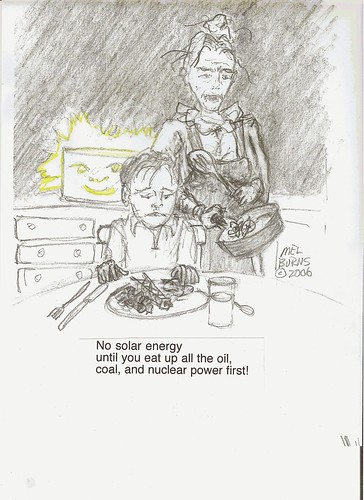
Anyway, another cartoon that's even more related to our topic, solar energy.
Disclaimer! picture taken from http://solarray.blogspot.com/2006/06/no-solar-energy.html.
& YING signed off @ 2:56 PM
the group
S ally (ting hui) K ai Lin Y i Hui (jewel) Y ing Hui
posting key
SALLY - Sally (ting hui)
Kai** - Kai Lin
frozen snowflake - Jewel
♥ ying - Ying Hui
the 'green' issue
Solar energy is basically converting the sun's rays into thermal energy for multiple purposes
such as heating homes, buildings, swimming pools and even greenhouses.
Solar energy can even be converted into electrical energy with the use of photovoltaic devices and solar power plants.
Most importantly, solar energy is a renewable source of energy that is free and unlimited.